pocket guide to the rosary
pocket guide to the rosary
The Rosary, a cherished Catholic devotion, beautifully blends prayer and meditation on the life of Jesus and Mary. This
spiritual practice, received in its present form around 1214, offers a pathway to deepen faith and find solace.
What is the Rosary?
The Rosary is fundamentally a scriptural prayer, a meditative form combining vocal prayers with contemplation on key events in the lives of Jesus and Mary. It’s comprised of core prayers – the Apostle’s Creed, Our Father, Hail Mary, Glory Be, and optionally, the Fatima Prayer – recited in a specific sequence.
A standard Rosary consists of five decades, each representing a specific mystery. These mysteries are categorized into four sets: Joyful, Sorrowful, Glorious, and Luminous. Praying the Rosary isn’t merely rote repetition; it’s an invitation to deeply reflect upon these mysteries, allowing them to inspire and transform one’s heart;
Considered a powerful spiritual tool, the Rosary is often given as a gift, symbolizing faith and offering comfort. It’s a portable prayer guide, easily accessible for personal devotion and a source of strength for Catholics worldwide.
Historical Origins of the Rosary (1214)
The Rosary, as we know it today, traces its origins back to 1214, a pivotal year in its development. Saint Dominic received the Rosary from the Blessed Virgin Mary as a powerful weapon against heresy. While earlier forms of prayer involving the recitation of Psalms existed, Dominic’s vision solidified the Rosary’s structure and purpose.
Initially, the Rosary consisted of the recitation of 15 Our Fathers and 15 Hail Marys, reflecting on 15 mysteries of Christ’s life. Over time, the Rosary evolved, with the addition of the Glory Be and the Fatima Prayer, further enriching its devotional character.
The Rosary’s spread was closely linked to the Dominican Order, who actively promoted it as a means of conversion and spiritual renewal. This historical context underscores the Rosary’s enduring significance within the Catholic tradition.
The Rosary as a Combination of Prayer and Meditation
The Holy Rosary isn’t merely rote recitation; it’s a profound synthesis of vocal prayer and mindful meditation. Each decade – a set of ten Hail Marys – is accompanied by contemplation on a specific mystery from the life of Jesus or Mary. This invites a deeper engagement with the Gospel narratives and fosters a personal relationship with God.
The repetitive nature of the prayers – Our Father, Hail Mary, and Glory Be – creates a rhythm that quiets the mind, allowing for focused reflection. Visualizing the scenes of the mysteries, aided by artwork or personal imagination, enhances the meditative experience.
This combined approach transforms the Rosary from a simple prayer exercise into a powerful tool for spiritual growth, offering solace, guidance, and a pathway to holiness.
The Core Prayers of the Rosary
Essential Rosary prayers include the Apostle’s Creed, Our Father, Hail Mary, Glory Be, and optionally, the Fatima Prayer, forming the foundation of this devotional practice.
The Apostle’s Creed
The Apostle’s Creed, a foundational statement of Christian belief, is recited at the beginning of each Rosary. It serves as a powerful affirmation of faith, outlining core doctrines about God the Father, Jesus Christ, the Holy Spirit, the Church, and the sacraments. This ancient creed encapsulates the essential tenets of the Christian faith, providing a unified expression of belief shared across denominations.
Reciting the Creed before embarking on the Rosary centers the prayer, grounding it in the fundamental truths of the Gospel. It’s a declaration of what Catholics believe, a profession of faith passed down through generations. The Creed reminds us of the mysteries we will contemplate during the Rosary, connecting us to the rich history and tradition of the Church. It prepares the heart and mind for a deeper encounter with God through Mary’s intercession.

The Our Father (Lord’s Prayer)
The Our Father, also known as the Lord’s Prayer, holds a central place within the Rosary, recited after each decade. Given to us by Jesus himself, it’s a perfect model for prayer, encompassing adoration, petition, and thanksgiving. This prayer acknowledges God’s holiness and invites His kingdom to come, seeking His will to be done on earth as it is in heaven.
Through the Our Father, we ask for daily bread – both physical and spiritual nourishment – and for forgiveness of our trespasses, mirroring our own willingness to forgive others. It’s a prayer of profound humility and trust in God’s providence. Reciting it repeatedly during the Rosary reinforces its message, deepening our relationship with the Father and aligning our hearts with His divine plan. It’s a universal prayer, uniting Christians across time and space.
The Hail Mary
The Hail Mary is the defining prayer of the Rosary, repeated ten times for each decade, following the Our Father. It’s a prayer of praise and petition, honoring the Virgin Mary, the Mother of God. The first part of the prayer draws from the Angel Gabriel’s greeting to Mary at the Annunciation – “Hail, Mary, full of grace, the Lord is with thee.”
We then invoke Mary’s intercession, asking her to pray for us sinners, now and at the hour of our death. This acknowledges Mary’s maternal role and her powerful advocacy on our behalf. The frequent repetition of the Hail Mary allows for deep contemplation of Mary’s virtues and her “yes” to God’s will. It’s a prayer that draws us closer to Christ through His mother, fostering a spirit of humility and surrender to God’s plan.
The Glory Be
The Glory Be, also known as the Gloria Patri, is a doxology – a hymn of praise to the Holy Trinity – recited at the conclusion of each decade of the Rosary. It’s a powerful affirmation of faith in God the Father, God the Son, and God the Holy Spirit. The prayer begins with “Glory be to the Father, and to the Son, and to the Holy Spirit.”
It continues by declaring that God was, is, and ever shall be, world without end. This emphasizes God’s eternal nature and unchanging love. Reciting the Glory Be after each decade serves as a reminder of the divine source of all blessings received through the Rosary’s meditation and prayers. It’s a fitting culmination to each set of ten Hail Marys, directing our adoration and gratitude towards the Trinity.
The Fatima Prayer (Optional)
The Fatima Prayer, also known as the Prayer of Grace, is a poignant plea for the intercession of the Immaculate Heart of Mary. While not a traditional part of the original Rosary, it was revealed by Our Lady during the apparitions at Fatima in 1917. It’s often recited after the Glory Be, concluding each decade with a heartfelt request for peace and salvation.
The prayer asks Mary to pray for us, sinners, now and at the hour of our death. It acknowledges our need for God’s mercy and relies on Mary’s maternal love to guide us. Many Catholics include this prayer as a sign of devotion and a commitment to living out the message of Fatima – repentance, prayer, and sacrifice for the conversion of sinners and the peace of the world. Its inclusion is a personal choice, enriching the Rosary experience.
Understanding the Mysteries of the Rosary
The Rosary’s twenty mysteries – Joyful, Sorrowful, Glorious, and Luminous – invite contemplation on key moments in Jesus and Mary’s lives, deepening our faith.
The Four Sets of Mysteries
The Rosary is structured around four distinct sets of mysteries, each offering a unique lens through which to contemplate the lives of Jesus and Mary. These twenty mysteries are thoughtfully categorized to facilitate deeper meditation and spiritual growth.
Firstly, the Joyful Mysteries focus on the early life of Jesus, beginning with the Annunciation and culminating in the Presentation in the Temple. Next, the Sorrowful Mysteries reflect upon the Passion of Christ, encompassing events like the Agony in the Garden and the Crucifixion.
Following these, the Glorious Mysteries celebrate the resurrection and ascension of Jesus, as well as the crowning of Mary as Queen of Heaven. Finally, added in 2002 by Pope John Paul II, the Luminous Mysteries illuminate pivotal moments in Jesus’ public ministry, such as His Baptism and the Transfiguration. Each set provides a rich tapestry for prayerful reflection.
The Joyful Mysteries
The Joyful Mysteries, the first set of Rosary meditations, invite us to contemplate the beginnings of the Gospel story – the dawn of salvation through the Incarnation. These five mysteries focus on moments brimming with hope and anticipation, centering around the blessed Virgin Mary and the infant Jesus.
We begin with the Annunciation, when the Angel Gabriel revealed to Mary that she would conceive and bear the Son of God. Next is the Visitation, Mary’s journey to assist her cousin Elizabeth. The Nativity follows, celebrating the birth of Jesus in Bethlehem.
Then comes the Presentation in the Temple, where Jesus was presented according to the law, and finally, the Finding in the Temple, when the young Jesus was discovered teaching in the Temple, showcasing His divine wisdom. Reflecting on these events fills the heart with joy and gratitude.
The Sorrowful Mysteries
The Sorrowful Mysteries guide us to contemplate the pain and suffering endured by Jesus during His Passion. These five mysteries invite empathy and a deeper understanding of Christ’s sacrifice for humanity, offering a path to spiritual growth through shared sorrow and compassion.
We begin with the Agony in the Garden, where Jesus prayed in anguish, anticipating His crucifixion. Next is the Scourging at the Pillar, a brutal punishment inflicted upon Him. The Crowning with Thorns follows, adding to His humiliation and pain.
Then comes the Carrying of the Cross, a physically and emotionally draining journey to Calvary, and finally, the Crucifixion and Death of Jesus, the ultimate act of love and redemption. Meditating on these events fosters a profound sense of reverence and gratitude for His sacrifice.
The Glorious Mysteries
The Glorious Mysteries celebrate the triumph of Christ and Mary, offering hope and assurance of eternal life. These five mysteries focus on the joy and glory that followed Jesus’s resurrection and ascension, and Mary’s assumption into Heaven, inspiring faith and devotion.
First, we contemplate the Resurrection of Jesus, the cornerstone of Christian belief, signifying victory over death. Next is the Ascension, where Jesus ascended into Heaven, preparing a place for us. The Descent of the Holy Spirit upon the Apostles follows, empowering them to spread the Gospel.
Then comes the Assumption of Mary into Heaven, body and soul, a testament to her holiness. Finally, we celebrate the Coronation of Mary as Queen of Heaven and Earth, recognizing her role as the Mother of God and our spiritual mother. Reflecting on these mysteries fills us with joy and anticipation of eternal glory.
The Luminous Mysteries
The Luminous Mysteries, added by Pope John Paul II, illuminate the hidden light of Christ during His public ministry. These five mysteries focus on events that reveal Jesus as the Messiah and Son of God, deepening our understanding of His divine identity and mission.
The first mystery is the Baptism of Jesus in the Jordan River, marking the beginning of His public life and revealing the Trinity. Next, we contemplate the Wedding at Cana, where Jesus performed His first miracle, demonstrating His power and glory. The Proclamation of the Kingdom of God follows, as Jesus preached repentance and offered salvation.
Then comes the Transfiguration, where Jesus revealed His divine glory to Peter, James, and John, foreshadowing His resurrection. Finally, we reflect on the Institution of the Eucharist, where Jesus offered His body and blood as the ultimate sacrifice. These mysteries invite us to encounter Christ’s radiant light.
How to Pray the Rosary: A Step-by-Step Guide
Praying the Rosary involves reciting the Apostle’s Creed, Our Father, Hail Marys, Glory Be, and optionally, the Fatima Prayer, while meditating on mysteries.
The Structure of a Rosary Decade
A Rosary decade, the fundamental building block of the prayer, consists of ten Hail Marys, separated by a single Our Father. Before commencing these prayers, the Apostle’s Creed is recited, establishing the foundation of faith. Each decade is dedicated to meditating upon a specific mystery – a pivotal event in the lives of Jesus and Mary, drawn from the Joyful, Sorrowful, Glorious, or Luminous Mysteries.
The process begins with holding the Rosary and announcing the mystery for that decade. Following the Our Father and ten Hail Marys, the Glory Be prayer is recited, offering praise to the Holy Trinity. Optionally, the Fatima Prayer can be added, seeking the intercession of the Immaculate Heart of Mary. This completes one decade, and the process is repeated for each of the five decades on a standard Rosary.
Understanding this structure allows for a focused and meaningful prayer experience, facilitating deeper contemplation of the mysteries and fostering a closer relationship with God.
Meditating on the Mysteries During Prayer
Central to Rosary prayer is the practice of meditating on the mysteries. It’s not merely reciting prayers, but actively contemplating the events in the lives of Jesus and Mary that each mystery represents. Visualizing the scene – the Annunciation, the Crucifixion, the Resurrection – allows for a more profound connection with the divine.
Utilizing imagery, such as the illustrations found in galleries dedicated to the Rosary’s twenty mysteries, can greatly enhance this meditative process. Consider the emotions of those present, the setting, and the significance of the event. Ask yourself how the mystery relates to your own life and spiritual journey.
This thoughtful reflection transforms the Rosary from a rote recitation into a powerful form of contemplative prayer, deepening faith and fostering a closer relationship with God through shared experiences.
Praying the Rosary Before Mass
Integrating the Rosary into your preparation for Mass is a deeply enriching practice. Praying the Rosary beforehand allows for a period of focused prayer and meditation, setting a reverent tone and preparing the heart to receive the Eucharist more fully. It’s a way to enter the liturgical celebration with a spirit of devotion and attentiveness.
Consider arriving at church with ample time to complete at least a portion of the Rosary – perhaps a decade or two – before Mass begins. This quiet time allows for personal reflection on the mysteries and a centering of oneself in God’s presence.
It complements the liturgical prayers and readings, enhancing the overall spiritual experience and fostering a deeper connection with the sacred mysteries celebrated during the Mass.
The 54-Day Rosary Novena (Petition & Thanksgiving)
The 54-Day Rosary Novena is a powerful devotion involving praying the Rosary consecutively for 27 days for a specific petition, followed by another 27 days in thanksgiving, regardless of the outcome. This sustained prayer is believed to be particularly effective due to its length and dedication.
Many Catholics and Christians participate in this novena, seeking intercession for various needs or expressing gratitude for blessings received. It’s a commitment to daily prayer, fostering a deeper relationship with Mary and a reliance on divine providence.
The structure – petition followed by thanksgiving – emphasizes trust in God’s will and a spirit of acceptance. It’s a practice often undertaken individually or within prayer groups, strengthening faith and community bonds.
The Rosary in Modern Practice
Today, the Rosary experiences revivals of interest, remaining a cherished gift and a source of comfort for many, often bestowed upon loved ones.
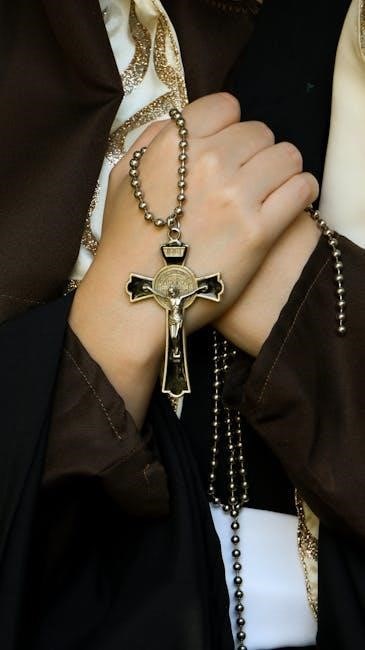
The Rosary as a Gift
The Rosary frequently serves as a deeply meaningful gift, exchanged amongst family and friends during significant occasions like Christmas or other special celebrations. This tradition reflects the Rosary’s enduring spiritual value and its capacity to offer comfort and connection. Presenting a Rosary isn’t merely offering a religious object; it’s bestowing a symbol of faith, hope, and a heartfelt prayer for the recipient’s well-being.
Scores of Catholics and other Christians incorporate the Rosary into their daily lives, demonstrating its widespread appeal and lasting relevance. The act of giving a Rosary signifies a desire to share the blessings of this devotion, encouraging others to explore its potential for spiritual growth and peace. It’s a tangible expression of care and a reminder of the power of prayer in navigating life’s challenges.
Revivals of Interest in the Rosary
Currently, the Rosary is experiencing a notable resurgence in popularity, drawing renewed attention from Catholics and beyond. This revival isn’t simply a return to tradition, but a rediscovery of the Rosary’s profound capacity to address contemporary spiritual needs. Authors and retreat leaders, like McKenna, are offering fresh perspectives on this ancient devotion, making it accessible and relevant to modern audiences.
This renewed interest suggests a growing desire for contemplative prayer and a deeper connection with the mysteries of faith. The Rosary provides a structured yet flexible framework for meditation, allowing individuals to engage with the lives of Jesus and Mary in a personal and meaningful way. It’s a powerful antidote to the distractions of modern life, offering a space for quiet reflection and spiritual nourishment.
Public Prayers Associated with the Rosary (St. Michael the Archangel)
Frequently, following the recitation of the Rosary, particularly in communal settings, the prayer to St. Michael the Archangel is offered. This practice isn’t intrinsically part of the Rosary itself, but has become a customary addition, reflecting a desire for divine protection and spiritual strength. It acknowledges St. Michael’s role as a defender of the Church and a vanquisher of evil.
The inclusion of this prayer highlights the broader context of Catholic devotion, where the Rosary is often linked to other expressions of faith and intercession. Liturgical considerations often guide the timing and appropriateness of such additions, ensuring they complement rather than overshadow the central focus on the Rosary’s mysteries. It’s a testament to the enduring power of communal prayer and the desire to seek heavenly assistance.